The Selmilab is named after Francesco Selmi (Vignola, 7 April 1817 – 13 August 1881) an Italian chemist, patriot, inventor and entrepreneur, one of the founders of colloid chemistry. Among all his interests, he was also a researcher of Dante Alighieri’s work. We are inspired by his life and work and we believe that nowadays he would be a great computational scientist.
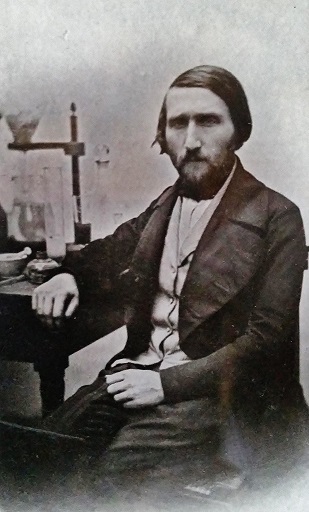
Chemist and Toxicologist
In 1839, earned a master’s degree in pharmacy from the University of Modena. He taught chemistry first at the Reggio Emilia high school, then at the University of Modena. Between 1845 and 1850, he published the first systematic studies on colloids, particularly on silver chloride, Prussian Blue, and sulfur compounds, identifying their main properties and distinguishing between true solutions and pseudo-solutions. Distinguished for his studies on colloidal states, fermentation, and electroplating, he was forced to flee to Turin after being caught up in the 1848 uprisings and sentenced to death by the Duke of Modena. He was appointed professor of physics, chemistry, and mechanics at the National College of Turin. In Turin, he discovered the lead tetrachloride with his colleague and friend Ascanio Sobrero. A few years after the unification of Italy, he left his ministerial career in Turin and, starting in 1867, took up the chair of pharmaceutical and toxicological chemistry at the University of Bologna where he began working in the previously unknown field of toxicological chemistry. He became the founder of modern forensic toxicology with the discovery of ptomaines, or cadaveric alkaloids. Selmi’s studies were responsible for saving many people falsely accused of poisoning, based on previously empirical and inaccurate scientific evidence
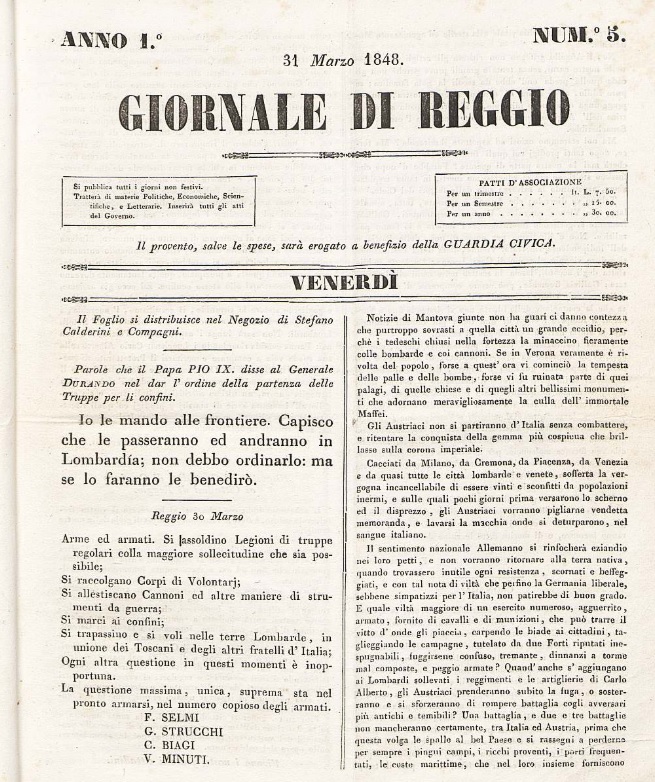
Patriot
Francesco Selmi participated in the 1848 uprisings against Austrian rule. That same year, he founded the Giornale di Reggio to incite the population of the Austro-Este Duchy to revolt against Austrian occupation. After the defeat of the Piedmontese army at Custoza, he fled to Turin and was later sentenced to death in absentia by Francis V of Austria-Este, Duke of Modena and Reggio. With the help of his wife Marietta, he helped many patriots flee the duchy and take refuge in Turin. In 1859, he, along with Giuseppe Verdi, was among the promoters of the accession of the province of Modena to the Kingdom of Savoy.

Philologist
In 1865 he published for the first time a group of exegetical notes in Florentine vernacular referring to the Inferno of Dante’s Divine Comedy dating back to the first decades of the fourteenth century discovered in the Magliabechiana library in Florence, today known as Chiose Selmi. In 1873 he published the Trattati morali di Albertano da Brescia, a 13th century Latin text, written by Albertano da Brescia and translated into the vernacular in 1268 by Andrea da Grosseto, discovered by Francesco Selmi in 1863 in the same library.
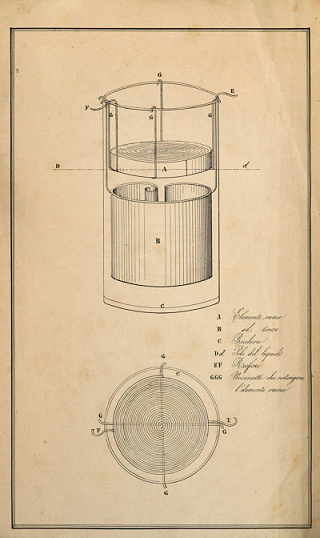
Inventor and entrepreneur
In 1854, he obtained a permit to extract guano in Sardinia to be used as a fertilizer. That same year, he filed two patent applications, one for a new method of producing coal gas for lighting and another for a new method of extracting rubber, sugar, alcohol, and paper fiber from herbaceous and woody plants. In 1855, he invented the triple-contact pile. The advantages of the new battery were its constant voltage, its low cost compared to existing batteries, its simplicity of construction and maintenance, and the absence of harmful fumes. The battery was used continuously in the Turin telegraph station from December 1856 until May 1857, where up to 100 cells were installed.
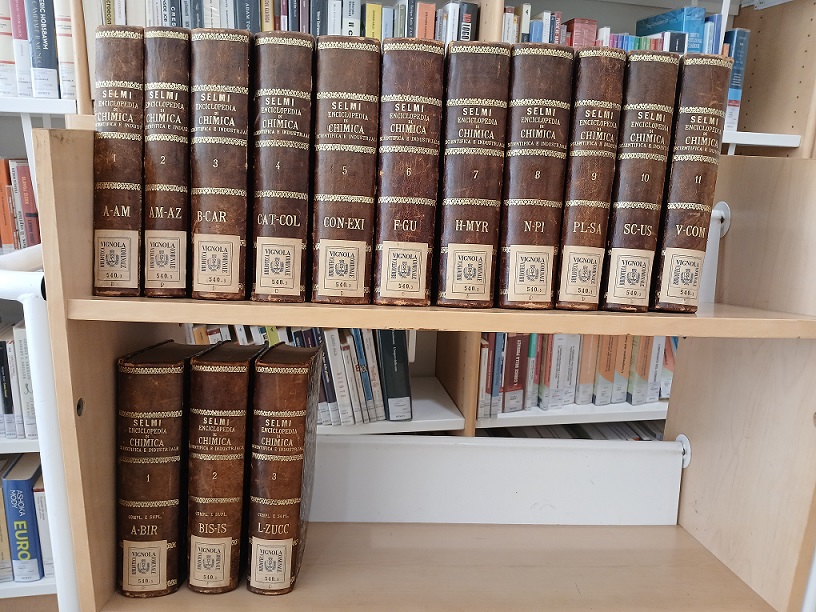

Author
Francesco Selmi was a prolific scientific author on colloid chemistry, electrochemistry, and toxicology. He published textbooks on organic and inorganic chemistry and was among the founders of two scientific journals. He published the first manual in Italy on electroplating and a manual for the production, conservation and chemical analysis of wine. In 1868, he edited the Enciclopedia di Chimica Scientifica e Industriale, consisting of eleven volumes plus three supplementary ones, the first encyclopedia of its kind published in Italy. He also published two novels, a collection of fairy tales, and the biographies of some public figures from Vignola.